Atlas Cue AcademyKNOWLEDGE CARRIED FORWARD™
Cue Makers · The artisans of our sport

Richard Black

The cue as canvas. For fifty years, Richard Black has made the pool cue into American art — by hand, one at a time, in Texas.

Richard Black Custom Cues · Brenham, Texas · Building since 1974

The maker

A stockbroker who found his canvas.

Missouri-born and Texan since the 1960s, Richard Black spent seventeen years in finance before cuemaking — taken up as a hobby, for relief — became the work itself. He had no formal training in machining or art. Starting in 1974, in his own words, he found that cues were meant to be his canvas; by 1976 he was building full-time.

He patterned his cues' joint and taper after Balabushka, then pushed the art further than the craft had gone: exotic hardwoods carrying ivory, mother-of-pearl, silver, gold and jewel inlay, with designs drawn from sources as eclectic as Gauguin, Picasso, Fabergé eggs and Parker pens. He still works alone — his wife Ardis runs the business side — and finishes just under twenty cues a year.

The champions noticed: Steve Mizerak, Jean Balukas, Ewa Mataya Laurance and Buddy Hall all played his cues. And the makers still gather around him — every year Black hosts Cuestock, the collectors' and cuemakers' get-together, at Blackwood on the Creek, his place in Brenham, Texas. The craft's family reunion was held there most recently on November 6–7, 2026.

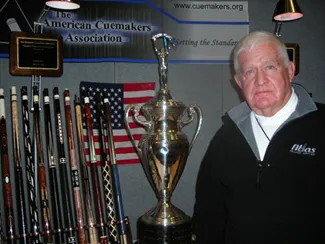
Richard Black beside a trophy and a rack of his cues at his American Cuemakers Association Hall of Fame induction
Richard Black at his American Cuemakers Association Hall of Fame induction in 2009, beside the trophy and a rack of his cues. Photo: Richard Black Custom Cues.
The work

Named like paintings, because they are.

Black names his cues the way painters name paintings. These examples are drawn from his own galleries at blackcues.com.

The Chantilly cue by Richard Black — dark wood with red and ivory-toned inlay

The Smithsonian cue · 1998

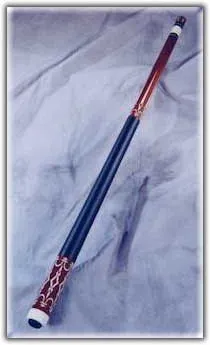
The Chantilly

It began as “Chantilly's Ring” — ivory inlays set into ebony — and grew, ring by ring, into the Chantilly: Cacique, a South American rosewood, worked with a single inlay material against a single field wood, the whole design built on what Black calls dynamic design flow.

In 1998 the Chantilly earned a permanent home at the Smithsonian's National Museum of American History in Washington, D.C. Black was one of twelve American cuemakers whose work the museum collected — a pool cue, placed by the nation's museum of history among the artifacts of American making.
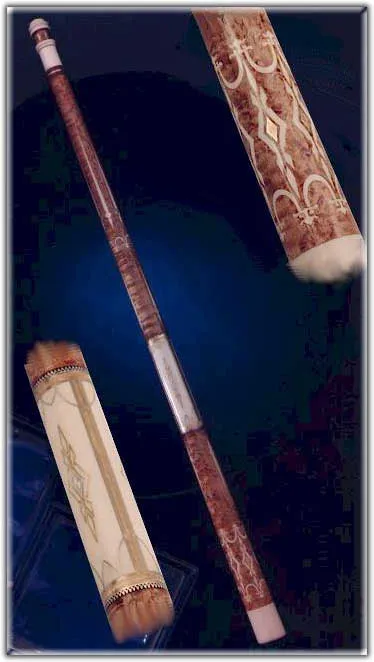
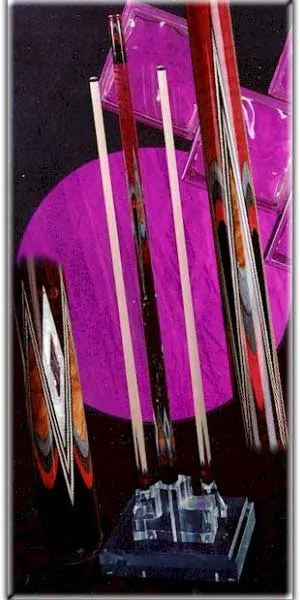
Chantilly Gold by Richard Black, full cue with detail views of its inlay

People's Choice · ICCS Houston 2007

Chantilly Gold

The last of the Chantilly line, premiered at the World Nine Ball Championships in Chicago in October 1997 and shown at the Gallery of American Cue Art in New York the following January. Black's own verdict, on his site: “the most beautiful cue I've ever made.” Voters at the 2007 International Cue Collectors Show in Houston agreed — they made it their People's Choice.

Athena by Richard Black, an art cue with bold diamond patterning, displayed on a stand

Best of Show, Silver Medal · Gallery Gala, New York 1999

Athena

Two years in the making. Diamond patterning of ebony and camateo against a nose of amarath and handle butterflies of madrone burl, with inlays of abalone, mother-of-pearl and silver — and a fine, fern-like silver line that wanders from the tips of the points up and around the handle. Named for the goddess who was patroness of the arts and crafts.

Rhapsody in Blue by Richard Black, blue and white diamond-patterned cue

From the Gallery of American Cue Art

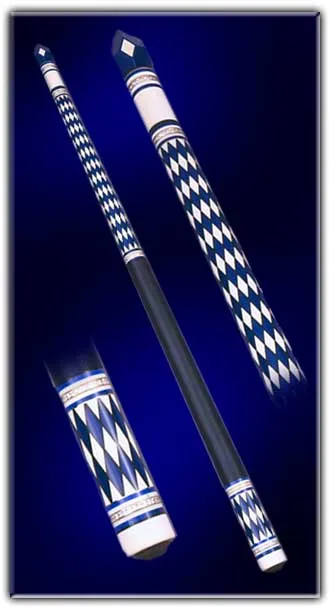
Rhapsody in Blue

A study in blue and white — hundreds of diamond inlays running the length of the cue. The Rhapsody name reached a wider audience in March 1999, when Black's Rhapsody appeared in the “Pool” episode of the television series The Pretender.

Smithson by Richard Black, warm rosewood-toned cue with ivory-toned inlay, shown full-length and in detail

From the Functional Art gallery

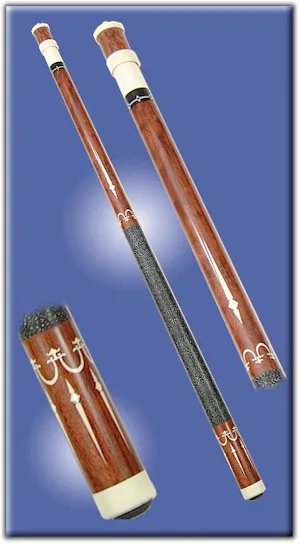
Smithson

From Black's Functional Art gallery: warm rosewood tones, a dark wrap, and fine ivory-toned inlay carried from the joint to the butt — the quieter end of his range, where the wood does most of the talking.

Honors

Three Halls of Fame, and the craft's own prizes.

  • 2009 — Hall of Fame inductee (twelfth), later selection-committee memberAmerican Cuemakers Association · inducted March 2009
  • 2017 — Hall of Fame inducteeInternational Cuemakers Association · December 2017
  • 2025 — Hall of Fame inductee, 2025 classTexas Billiards Hall of Fame · inducted September 2, 2025, Round Rock
  • 2017 — Trailblazers Award, first recipientInternational Cue Collectors Association · August 2017
  • 2011 · 2012 — Grand Collection Award, for Venetian Dream and The JesterInternational Cue Collectors Show
  • 2010 — Collectors Choice Award, for SquaredInternational Cue Collectors Show · Sarasota
  • 2007 — People's Choice Award, for Chantilly GoldInternational Cue Collectors Show · Houston
  • 1999 — Best of Show, Silver Medal, for AthenaGallery Gala · New York City
  • 1993 — Best of ShowAmerican Cuemakers Association Cue Expo · Houston
  • Winner, The Josswest PrizeFor extending the design possibilities of the cue through new technology
  • 2005 — “The Art of Cue,” the cuemaking industry's first solo art-museum exhibitionArt Museum of Southeast Texas · Beaumont
  • 1990 — Steve Mizerak's Complete Book of Pool dedicated to him“To Richard Black, for renewing my interest in pool”

Sources. Biography, craft details, the Chantilly's history and the honors list: Richard Black Custom Cues (blackcues.com — About, Museum Exhibits, Awards & Honors, and Gallery pages). Hall of Fame induction, 2017: International Cuemakers Association (internationalcuemakers.com). Texas Billiards Hall of Fame 2025 class: EIN Presswire, August 3, 2025.

The Smithsonian, stated exactly: Black's own Museum Exhibits page records that one of his cues has been in the Smithsonian's National Museum of American History since 1998; the International Cuemakers Association records that he earned the right to gift a cue for display there; coverage of The Genuine Article (Fine Living Network) names the cue as the Chantilly and dates its permanent home at the museum to 1998; Black was one of twelve American cuemakers the museum collected in that period.

Photographs from Richard Black Custom Cues (blackcues.com)

← All cue makers