Atlas Cue AcademyKNOWLEDGE CARRIED FORWARD™
Next room →
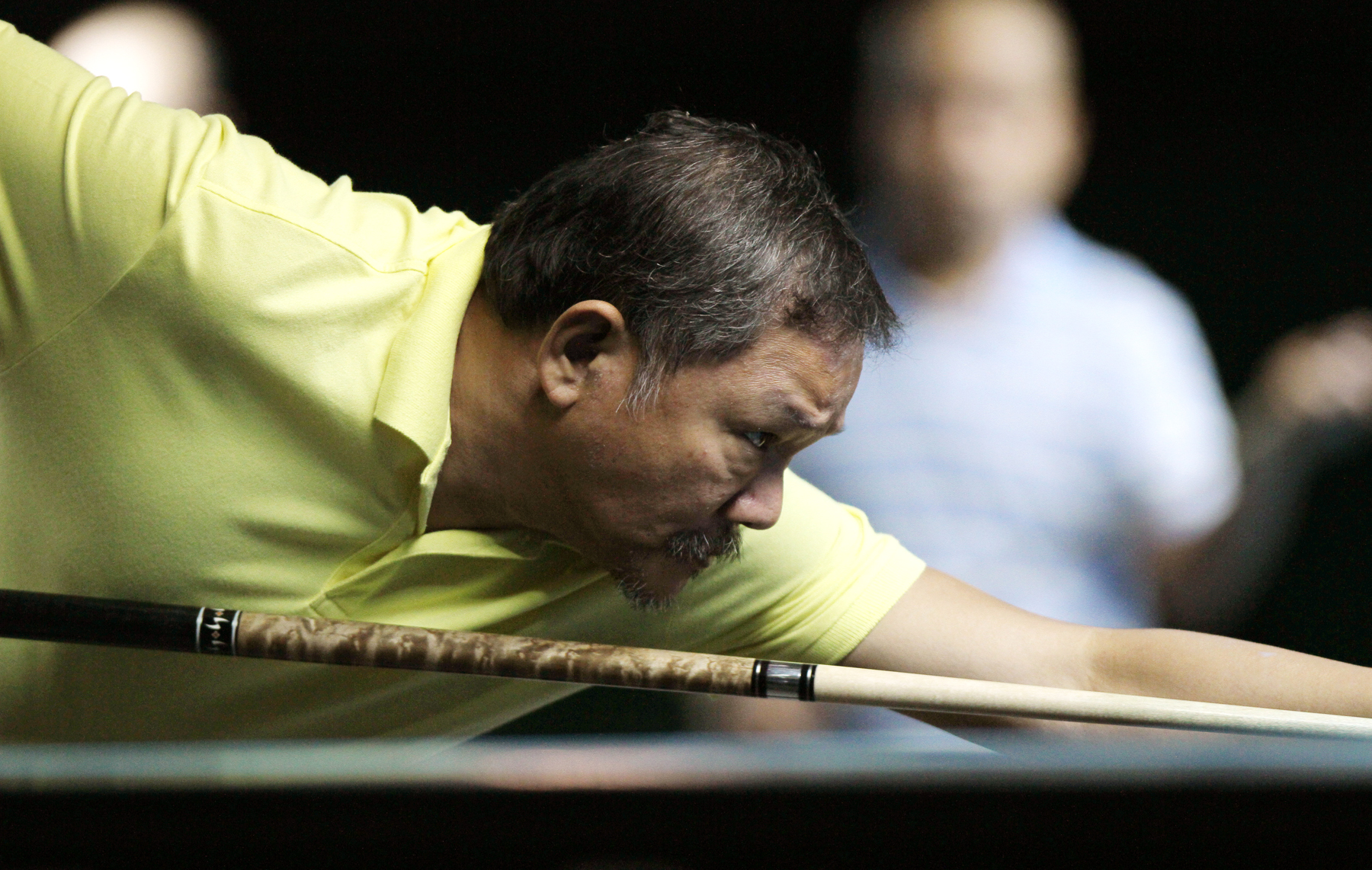
Hero photograph · Shane Van Boening · Christian Werner · CC BY 3.0 · credits
Practice · Analyze · Improve

Training Pavilion

A brighter working room inside Atlas—where visual instruction, structured drills turn understanding into repeatable skill.

03Atlas Cue Academy
Explore↓
Do this now

Predict before you shoot.

Where do you hit the cue ball? Where does the object ball meet the rail? Where does the rebound go?

Visually Intelligent Practice™

Make the invisible visible.

The Training Pavilion converts abstract aiming, contact, rebound and spin into a visual practice language.

Watch · The one-rail bank — the mirror point, in 25 seconds. Then take it to the practice table below.
Watch · The three-rail bank — three cushions, one true track, in 25 seconds. Then take it to the practice table below.
Watch · The Z shot — two cushions and a crossing track, in 25 seconds. Then take it to the practice table below.
Watch · The five-rail bank — five cushions, all the way around, in 25 seconds. Then take it to the practice table below.
Watch · Corner to Corner — one rail, equal in and equal out, in 25 seconds. Then take it to the practice table below. Practice this shot in the simulator →
Watch · End Rail to Corner — one rail, the full length of the table, in 25 seconds. Then take it to the practice table below. Practice this shot in the simulator →
Watch · Top Rail Kick Bank — up off the top rail and back down to the corner, in 25 seconds. Then take it to the practice table below. Practice this shot in the simulator →
Watch · Sharp Rail Cut — tight to the right rail, a steep bank home, in 25 seconds. Then take it to the practice table below. Practice this shot in the simulator →
Watch · Side Pocket 1-Rail — off the bottom rail, into the side pocket, in 25 seconds. Then take it to the practice table below. Practice this shot in the simulator →
Watch · Left Rail Cross-Corner — off the left rail, across the full width, in 25 seconds. Then take it to the practice table below. Practice this shot in the simulator →
Watch · Cross-Corner 2-Rail — the most common two-rail bank in pool, in 25 seconds. Then take it to the practice table below. Practice this shot in the simulator →
Watch · End-Long 2-Rail — the long way around, two rails home, in 25 seconds. Then take it to the practice table below. Practice this shot in the simulator →
Watch · 2-Rail to Side Pocket — two rails into the side pocket, in 25 seconds. Then take it to the practice table below. Practice this shot in the simulator →
Watch · Two-Cushion Long — a full-length bank, off the bottom and right rails, in 25 seconds. Then take it to the practice table below. Practice this shot in the simulator →
Watch · Short-Long 2-Rail — short rail first, then the long rail home, in 25 seconds. Then take it to the practice table below. Practice this shot in the simulator →
Watch · Classic 3-Rail Corner — the foundational three-rail pattern, in 25 seconds. Then take it to the practice table below. Practice this shot in the simulator →
Watch · 3-Rail Reverse — the classic pattern, mirrored, in 25 seconds. Then take it to the practice table below. Practice this shot in the simulator →
Watch · Short-Rail First 3-Rail — it opens on the short rail, in 25 seconds. Then take it to the practice table below. Practice this shot in the simulator →
Watch · Up-and-Around 3-Rail — up and around the whole table, in 25 seconds. Then take it to the practice table below. Practice this shot in the simulator →
Watch · Around the Table — all the way around the table, in 25 seconds. Then take it to the practice table below. Practice this shot in the simulator →
Watch · 4-Rail Cross Pattern — two banks woven into one, in 25 seconds. Then take it to the practice table below. Practice this shot in the simulator →
Watch · 4-Rail Side System — four rails, home in the side, in 25 seconds. Then take it to the practice table below. Practice this shot in the simulator →
Watch · Full Table Circuit — the full circuit of the table, in 25 seconds. Then take it to the practice table below. Practice this shot in the simulator →
Watch · 5-Rail High-English — five rails, running english, in 25 seconds. Then take it to the practice table below. Practice this shot in the simulator →
Visual practice · one-cushion bank

One rail. See what changes.

Move the dot on the small cue ball, or choose Center, Left or Right. Set a speed. Play the shot, watch the cushion contact, then compare the orange bank with the pale center-hit reference.

Interactive top-down pool tableA cue ball strikes an orange object ball toward the top cushion. The rebound path changes with the selected tip and cushion aim.
Center · StunMove the tip dot

Ready · white cue ball → orange ball → blue cushion contact → rebound

Start with Center and Medium. Change one control, then play again.

Orange: object-ball bankPale dashed: Center / MediumWhite: cue ballCyan: follow / drawBlue: cushion contact

Medium speed: the starting reference. Compare Soft and Firm at the same aim.

What the tip position means

Center tip: start here. The pale dashed path is Center / Medium at the same aim. Compare speed first, then add sidespin.

Top shows follow; bottom shows draw; the horizontal middle shows stun at impact in this full-ball teaching setup. The dot illustrates contact on the cue ball as viewed from behind the cue. The cyan line previews its movement after contact.

At this aim and speed, will the selected tip run shorter, the same, or longer than center?

A bank sends the orange object ball to a cushion first. Follow/draw motion is an illustrative full-ball comparison; it is not a calibrated prediction. Vertical selection changes the cue-ball route here, while the orange bank uses the existing sidespin/speed model. Center-tip contact alone does not guarantee stun on a real table. Pale comparison stays at Center / Medium with your current aim. Angle arcs and the spin ring are visual guides, not measured spin or calibration. This is a qualitative comparison with spin transfer exaggerated for visibility. Soft speed lengthens and firm speed shortens this teaching model; these effects and spin transfer are exaggerated. Real throw, cloth and cushions change the result; the lines are a starting reference, not a guaranteed aim.

More bank-shot instruction

Atlas drew this diagram independently. Continue with Zero-X kicking and banking or Dr. Dave’s bank and kick effects.

The library grows

Kick Shots

The first taste of the Kick Shots collection — free for everyone. The full library is on its way for members.
Watch · K1·01 Through-Diamond Kick — The first kick to learn — a rolling ball, aimed through the diamonds, in 25 seconds.
Watch · K1·03 Equal-Distance Mirror Kick — No counting, no diamonds — just match the two distances and split the middle, in 25 seconds.
Watch · K1·04 Kick to the Side Pocket — A ball hanging over the side pocket — come off the bottom rail and drop it in, in 25 seconds.
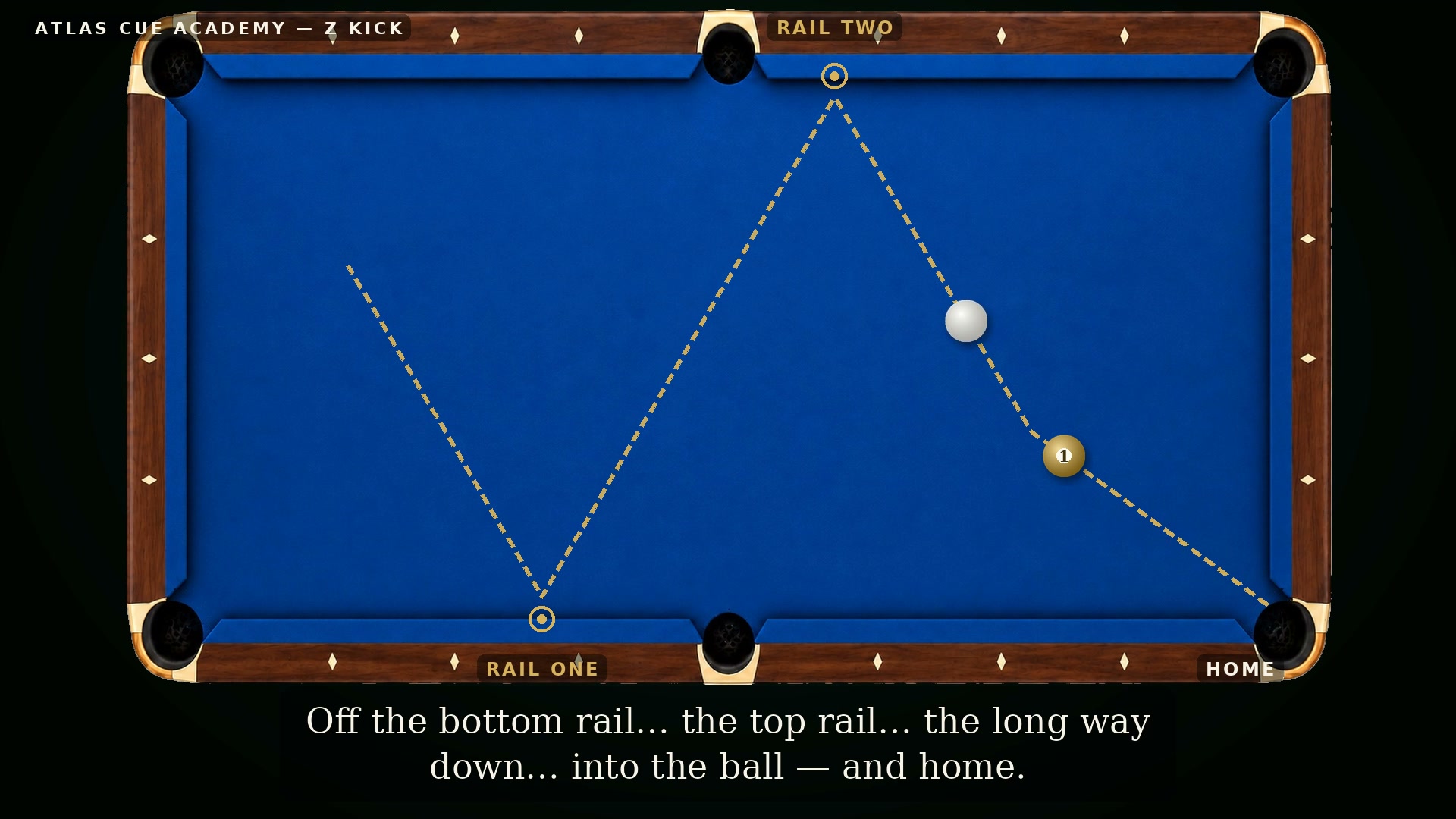
MembersK2-07 Z Kick diagram: the cue ball strikes one long rail then the other, reaching an object ball tucked by the corner pocket
K2·07 Z Kick. The Z — both long rails, the whole table twice, to reach a ball with no direct road. The first film in the members' library.
Members only. The three Kick Shots above stay free for everyone, always — membership opens the deep library as it grows.
See membership Sign in
From the screen to the cloth

The Practice Notebook

See it. Simulate it. Do it. Write it down.

Twenty shot-log pages built on the Loop — watch the film, run the shot in the simulator, take it to the cloth for ten reps, then write the record: the shot, your score out of ten, and what you felt on the misses. Your misses are the lesson plan.

Free when you join Atlas — leave your name and email and the book is yours.

© Bob Saint John 2026 · Free for your own practice.

Watch · Go Deeper

From Dr. Dave

The systems behind these lessons, taught by the man who documented them. Each video plays right here.

Top 10 Bank & Kick Aiming Systems — the mirror system from Lesson 1, the Corner Five from our 3-rail shots, and eight more ways to aim.
The Corner-5 System — the diamond system behind our R3 lessons, taught by Dr. Dave and Tom Ross.
The Diamond System You Must Know — the rolling-ball 2-to-1 system, and how to correct it when a table banks long or short.
Bank & Kick Effects and Adjustments — speed and spin move every bank. The honest limits, from the man who measured them.

More at Dr. Dave’s YouTube channel — it opens in a small window, so Atlas stays right here behind it.

Overhead video · visual learning

Geometry of Pool

Want to see cushion routes in action? Explore Juss’s “From the cushion” overhead videos, with illustrated paths that help you follow angles and spin around the table.

Visit Geometry of Pool on Instagram ↗

An independent learning resource, introduced with permission. Meet the resource →

Keep moving

Open the next door

Continue through the Academy without returning to a menu.

→
Belong to the Academy

Knowledge is open.
Your journey can be personal.

Explore Atlas freely. Join when you want the Academy to remember where you have been, what you want to revisit, and how you want to participate.

The principle
Free to explore.

History, instruction, people, culture and the core Academy remain open. Paid experiences belong later—only where Atlas or its partners provide additional value.